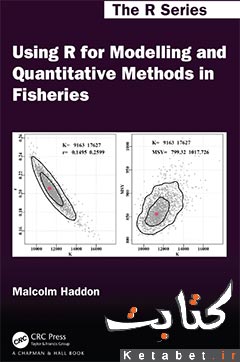
Using R for Modelling and Quantitative
Methods in Fisheries has evolved and
been adapted from an earlier book by the
same author and provides a detailed
introduction to analytical methods
commonly used by fishery scientists,
ecologists, and advanced students using
the open-source software R as a
programming tool. Some knowledge of R is
assumed, as this is a book about using
R, but an introduction to the
development and working of functions,
and how one can explore the contents of
R functions and packages, is provided.
The example analyses proceed
step-by-step using code listed in the
book and from the book’s companion R
package, MQMF, available from GitHub and
the standard archive, CRAN. The examples
are designed to be simple to modify so
the reader can quickly adapt the methods
described to use with their own data. A
primary aim of the book is to be a
useful resource to natural resource
practitioners and students.
Featured Chapters:
Model Parameter
Estimation provides a detailed
explanation of the requirements and
steps involved in fitting models to
data, using R and, mainly, maximum
likelihood methods.
On Uncertainty uses R
to implement bootstrapping, likelihood
profiles, asymptotic errors, and
Bayesian posteriors to characterize any
uncertainty in an analysis. The use of
the Monte Carlo Markov Chain methodology
is examined in some detail.
Surplus Production
Models applies all the methods examined
in the earlier parts of the book to
conducting a stock assessment. This
included fitting alternative models to
the available data, characterizing the
uncertainty in different ways, and
projecting the optimum models forward in
time as the basis for providing useful
management advice.
..
◄ مطالعه
این کتاب برای کلیه علاقمندان شیلات و
انفورماتیک و برنامه R، برای نوشتن مقاله و
پایاننامه مفید است.